
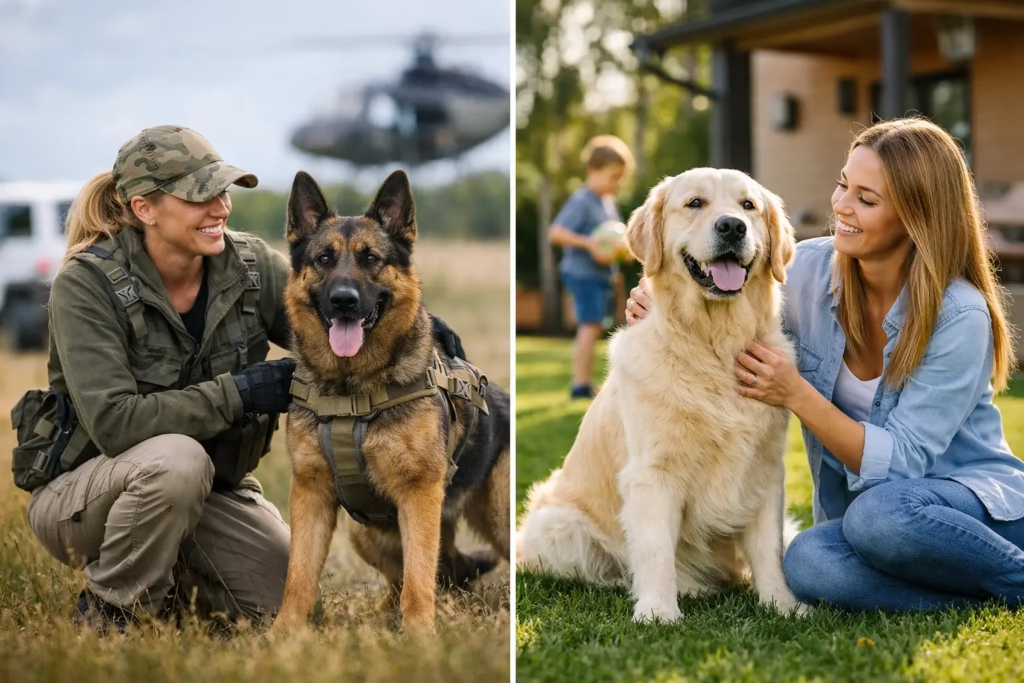
A Belgian Malinois can be devoted to its family and highly capable in demanding work, but those traits do not automatically make every puppy right for every household. The working dog versus family dog question is less about whether one type is better than the other and more about whether a dog’s genetic traits, early development, and daily environment fit the life its owner can provide.
For prospective Malinois owners, this distinction deserves honest attention before bringing home a puppy. A dog with confidence, athleticism, and strong trainability can be an exceptional companion when those qualities are directed well. Without consistent structure, however, the same qualities can become difficult to manage.
Working Dog Versus Family Dog: What Changes?
A working dog is bred, raised, and trained with a job in mind. That job may involve law enforcement, personal protection, search and rescue, military service, detection, herding, or competitive dog sports such as IGP, obedience, agility, and dock diving. The dog is expected to engage with a handler, perform under pressure, recover quickly from stimulation, and maintain focus around distractions.
A family dog’s primary job is different. The dog still needs training, exercise, boundaries, and engagement, but daily success is measured by safe, stable behavior in the home. A suitable family companion should be able to settle after activity, live appropriately around household routines, and build a reliable relationship with each member of the family.
These descriptions can overlap. Many Belgian Malinois have the intelligence and loyalty to participate in sports or advanced training while living as cherished family dogs. The key is that family life cannot be an afterthought. A serious working prospect may require more intensity, more experienced handling, and a more demanding training schedule than an active home can reasonably maintain.
Drive Is Not the Same as Energy
People often describe the Belgian Malinois as high energy, but energy is only part of the picture. Drive is the dog’s desire to pursue and engage with a reward, task, object, scent, movement, or interaction. A dog with strong toy, food, prey, or defense drive may be highly motivated to work, yet that motivation needs clear outlets and guidance.
A long walk or a large yard does not replace purposeful work for a high-drive dog. Physical exercise matters, but a Malinois also needs mental effort. Obedience sessions, controlled play, tracking, scent work, agility foundations, and problem-solving activities can help meet that need. Just as important, the dog must be taught how to transition from activity into calm behavior.
For family homes, a moderate and balanced temperament is often more valuable than maximum intensity. A puppy can be confident, alert, athletic, and eager to learn without needing to operate at the highest level of working drive. Responsible breeders evaluate puppies and parent dogs with placement in mind rather than assuming every buyer needs the most intense prospect in a litter.
Temperament Determines More Than Trainability
Trainability is a major strength of the Belgian Malinois, but a dog that learns quickly also learns unwanted habits quickly. Jumping, leash pulling, demand barking, guarding toys, chasing moving children, or reacting to visitors can become established if the owner does not provide consistent rules from the beginning.
A working dog may show greater persistence in a task, faster responses to environmental change, and a stronger desire to engage with its handler. Those traits are valuable in performance and service roles. In a family setting, they must be paired with stability, neutrality when appropriate, and an ability to settle. A dog should not need to greet every stranger, but it should be safe, controllable, and responsive.
This is why responsible breeding begins with more than appearance. Health evaluations, documented lineage, sound structure, and stable parent temperament all matter. Puppies inherit tendencies, not finished behavior, but thoughtful breeding gives owners a stronger foundation to build on through socialization and training.
The Family Lifestyle Test
Before choosing a Belgian Malinois, buyers should consider their actual routine rather than their ideal routine. A family that enjoys hiking on weekends may still have limited time for training during busy work and school weeks. A first-time dog owner may be committed and capable, but should be honest about whether they have access to qualified training support and the willingness to practice daily.
A Malinois can be a good family dog when the adults in the household take responsibility for its education. Children should never be expected to manage the dog’s exercise, impulse control, or behavior around guests. Adult supervision is especially necessary during play, meal times, and introductions to new people or animals.
The home itself also matters. A securely fenced yard can be useful, but it is not a substitute for supervised activity. Apartment living is possible for some owners, provided they can meet the dog’s exercise and training needs consistently. A rural property may offer space, but a dog can still become frustrated or undertrained if it spends most of its time alone outdoors.
Training Expectations for Each Path
Every Belgian Malinois should learn practical household skills: recall, leash manners, place or settle behavior, crate comfort, impulse control, appropriate greetings, and reliable obedience around distractions. These are not optional extras for a powerful, athletic breed. They create freedom and safety for the dog and the people around it.
A working or sport-focused dog usually needs training that goes farther. The handler may build formal heeling, tracking, bite-work foundations with qualified professionals, advanced retrievals, obstacle confidence, or task-specific obedience. The training is more technical, and the consequences of unclear handling are greater. Protection training, in particular, should never be attempted casually or through online advice. It requires knowledgeable instruction, suitable dogs, and responsible management.
Family-oriented Malinois also benefit from a structured plan. Short, frequent sessions often work better than occasional marathon lessons. Puppy classes, a trainer experienced with working breeds, controlled exposure to new environments, and clear household routines can make a substantial difference. Early socialization should build confidence, not force interaction. A puppy does not need to meet everyone; it needs to learn that new people, places, surfaces, sounds, and routines can be handled calmly with its owner’s guidance.
Why Puppy Matching Matters
Not every puppy in a well-bred litter has the same temperament, confidence level, recovery, food motivation, or intensity. One puppy may be a promising choice for an experienced sport handler, while another may be better suited to an active family committed to obedience and outdoor activities. Neither placement is lesser. The right placement gives each puppy the greatest opportunity to thrive.
At Black Rose Malinois, responsible placement begins with careful attention to the traits that matter over a dog’s lifetime: health, structure, confidence, trainability, and temperament. Daily handling and early socialization help puppies begin life with positive human interaction, while breeder guidance helps buyers understand the commitment ahead.
Buyers should be prepared to discuss their prior dog experience, household members, other pets, activity level, training goals, and expectations for the dog. A reputable breeder may ask direct questions or recommend a different puppy than the one a buyer first notices. That is not a barrier to purchase. It is a sign that long-term fit matters more than making a quick sale.
Choosing the Right Standard of Success
A working dog does not need to be busy every second, and a family dog should not be treated as low-maintenance. Both need clarity, companionship, physical conditioning, and a handler who follows through. The difference is the level and type of work the dog is bred and expected to perform.
For some owners, success means a Malinois that competes, tracks, protects, or serves in a demanding role. For others, success means a well-trained dog that hikes with the family, settles calmly in the house, and remains a confident, loyal companion. Both outcomes can honor the breed when the dog’s needs and the owner’s capabilities are matched honestly.
The best choice is not the puppy with the biggest reputation or the highest apparent drive. It is the puppy whose temperament, potential, and support needs fit the home that is ready to guide it for life.